Cut Your Meetings by 60%: The Async-First Communication Playbook for Freelancers
The average freelancer spends 12+ hours per week in meetings. Most of those meetings could be a 3-minute Loom video, a shared doc, or a Slack thread. This playbook gives you the decision framework, the replacement templates, and the client scripts to reclaim those hours without losing a single relationship.
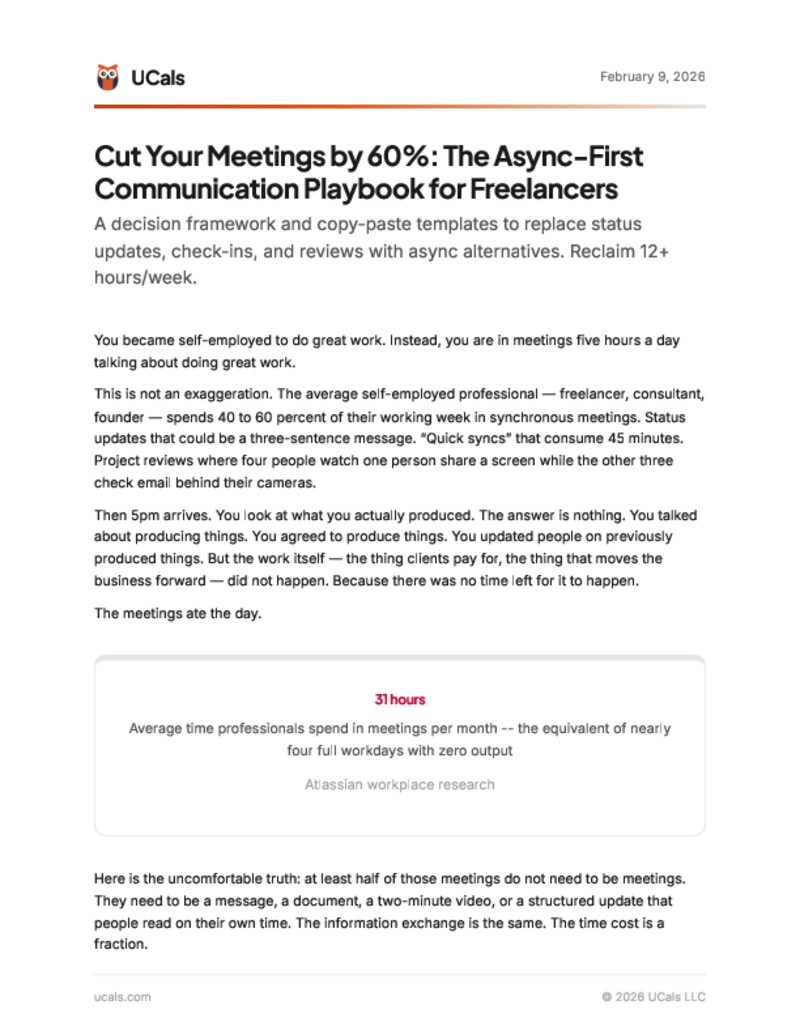
What's inside
- Meeting Decision Tree to evaluate every recurring call
- 5 copy-paste async replacement templates
- Scripts for pitching async to meeting-heavy clients
- Guide to redesigning your reclaimed calendar time
Free. No spam. Unsubscribe anytime.
Downloaded by 98+ professionals.
Who this is for
- Freelancers and consultants drowning in status update meetings
- Solopreneurs whose calendar is 60%+ meetings with no time for actual work
- Remote workers who want to propose async alternatives without seeming difficult
- Anyone who has left a meeting thinking "this could have been an email"
Frequently asked questions
What is async-first communication?
Async-first means defaulting to asynchronous communication -- messages, documents, video recordings -- and only scheduling live meetings when real-time interaction is genuinely necessary. It does not mean eliminating all meetings. It means treating meetings as a last resort rather than the default for every interaction.
How many meetings can realistically be replaced with async?
Based on the decision framework in this playbook, 40 to 60 percent of recurring meetings can be replaced with async alternatives. Status updates, progress check-ins, routine reviews, and information-sharing meetings are the strongest candidates. Strategy sessions, difficult feedback conversations, and relationship-building meetings should usually stay live.
How do I convince clients to try async communication?
The playbook includes word-for-word scripts for proposing async alternatives. The key is framing it as a benefit to them: faster turnaround, written records they can reference, and less time spent in meetings. Most clients care about results, not the format of the communication.
Will going async hurt my client relationships?
The opposite is usually true. Clients value responsiveness and results, not meeting frequency. A well-structured async update that arrives at 9am is often more valued than a 30-minute call that interrupts their day. The playbook shows how to maintain relationship quality while reducing meeting quantity.
What tools do I need for async communication?
No specialized tools required. Email, a screen recording tool (Loom has a free tier), shared documents (Google Docs), and your existing messaging platform cover every async format in this playbook. The templates work with whatever tools you already use.
Get the free framework
Enter your email and it's yours.
Free. No spam. Unsubscribe anytime.
Published by UCals team · Last updated February 9, 2026 · 14 min read