What's Your Calendar Health Score? The 2-Minute Assessment That Reveals Your Scheduling Blind Spots
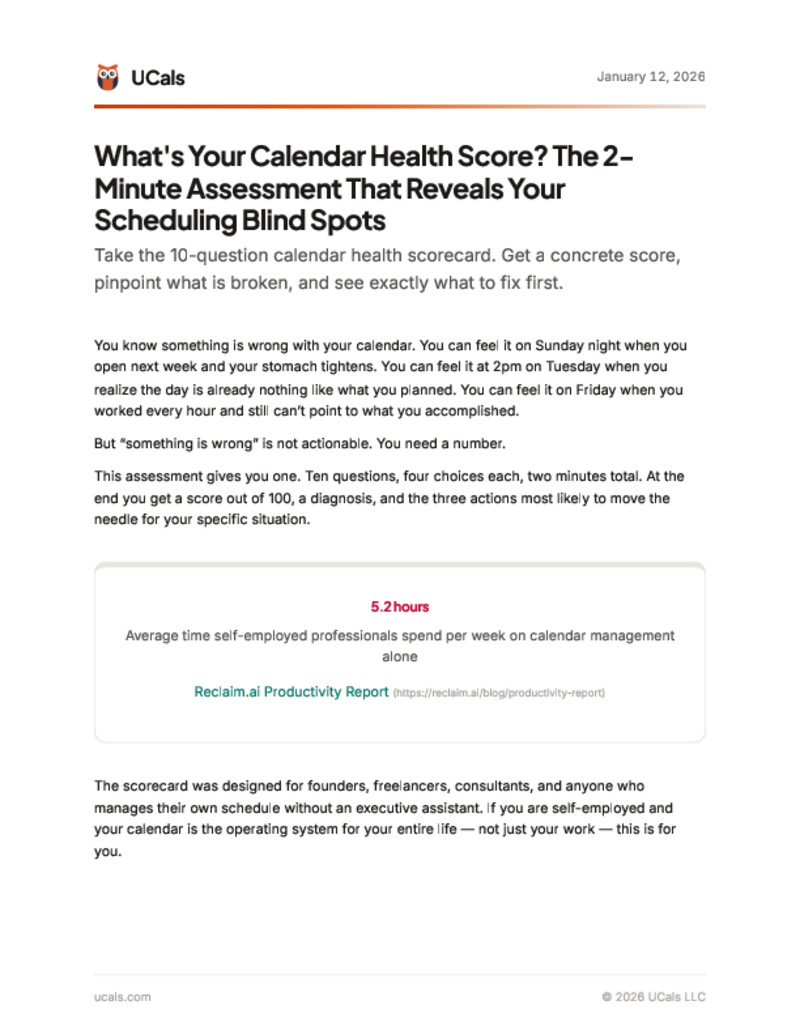
Ten questions. Two minutes. A concrete score that tells you whether your calendar is working for you or against you. Most professionals have never measured their scheduling health -- they just know something feels off. This scorecard turns that feeling into a number and tells you exactly what to fix first.
What's inside
- 10 diagnostic questions that reveal your calendar's hidden problems
- A scored result with 3 tiers: Healthy, At Risk, and Needs Attention
- The single highest-impact fix for each score range
- Comparison benchmarks: how your score compares to other self-employed professionals
- A printable scorecard you can revisit monthly to track improvement
Free. No spam. Unsubscribe anytime.
Downloaded by 83+ professionals.
Who this is for
- Self-employed professionals who feel their calendar controls them, not the other way around
- Freelancers and founders who want a quick diagnostic before overhauling their schedule
- Anyone curious about how their scheduling habits compare to best practices
- Professionals considering a calendar tool switch who want to identify problems first
Frequently asked questions
What is a calendar health score?
A numeric assessment of how well your schedule supports your productivity, well-being, and goals. It measures buffer time between events, deep work protection, meeting density, personal time allocation, and schedule flexibility. A high score means your calendar is structured to protect your best work. A low score means it is working against you.
How is this different from a calendar audit?
A calendar audit is a detailed 25-point analysis that takes 10 minutes. The health scorecard is a quick 2-minute diagnostic -- 10 questions that give you an overall score and direction. Think of the scorecard as a screening test and the audit as the full examination. Start with the scorecard; if your score is low, follow up with the audit.
What score should I aim for?
Above 70% indicates a healthy, well-structured calendar. Between 40% and 70% means specific areas are dragging your schedule down. Below 40% suggests structural issues likely costing multiple hours per week. Most self-employed professionals score between 35% and 55% on their first assessment.
Can I improve my score without changing calendar tools?
Yes. Most improvements come from structural changes -- adding buffers between meetings, protecting deep work blocks, batching similar tasks, and blocking personal time. These work in any calendar app. The scorecard identifies which changes will have the most impact for your specific situation.
How often should I check my calendar health?
Monthly. Your schedule drifts over time -- meetings accumulate, buffers get deleted, deep work blocks shrink. A monthly 2-minute check catches these patterns before they become entrenched. If you score below 40%, check weekly until the score improves.
Get the free scorecard
Enter your email and it's yours.
Free. No spam. Unsubscribe anytime.
Published by UCals team · Last updated January 12, 2026 · 9 min read